
b4b Global Edge's leadership breakfast unpacks AI, visibility and what is actually driving B2B growth right now.
Most B2B leaders we speak to are not struggling with activity. They are struggling with being known, trusted and chosen. That is exactly where we started on the 26th of February at The NICI.
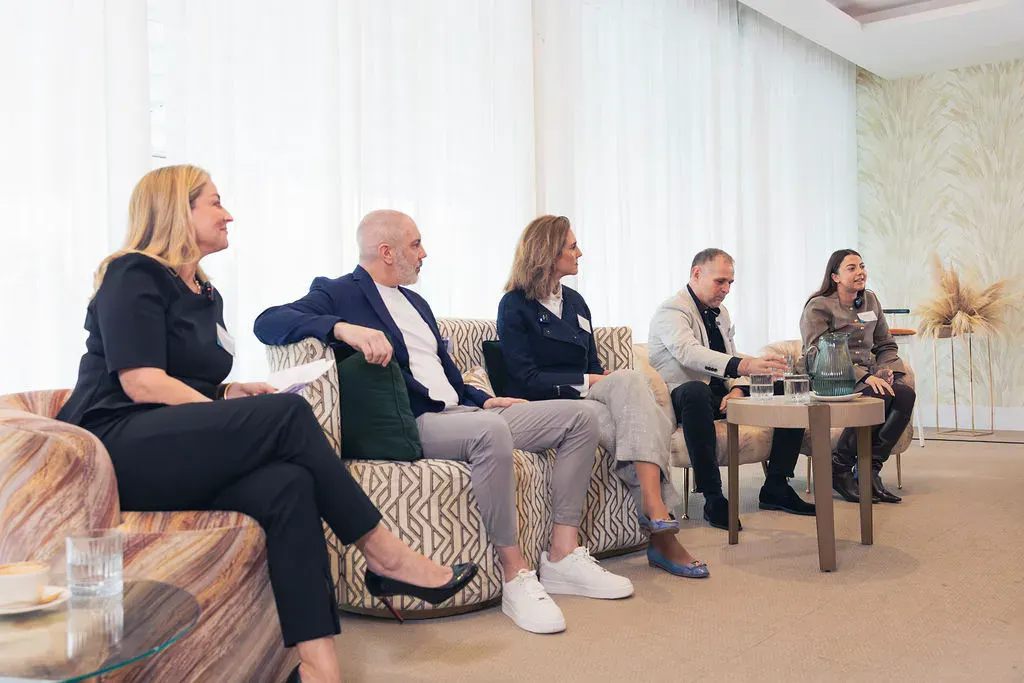
I hosted the morning's discussion for thirty senior B2B leaders alongside a panel who brought real experience and no filter. The theme: PR is Dead. AI is Loud. So what actually works for B2B growth now? We could have gone on for another hour, and that tells you everything about whether we got the room right.
This write-up is for everyone who was there and wants a record of what was said, and for everyone who was not but wants to know what they missed.
The Panel
We chose four people from different sectors, different sizes and different entry points with the same problem.
Andy Strong
Andy Strong is the founder of Strong Search, which helps high-growth SaaS companies build their global commercial teams. He has built his business entirely through relationships and visibility, and came with sharp, practical experience of what that looks like in practice.
Nikki de Kretser
Nikki de Kretser leads marketing at RTGS.global, a digital cross-border payments platform. She has spent her career in high growth tech companies working out how to build genuine emotional connection with B2B audiences across different cultures and countries.
Steve Bolton
Steve Bolton is an entrepreneur, investor and creator of The Veritas Method, with four decades of founding, scaling and investing in businesses. In April he is launching an AI coaching and training company focused on how humans and technology work best together. He came with a clear lens on where AI is reshaping leadership and competitive advantage right now.
Liv Clark
Liv Clark is our Head of Events at b4b Global Edge and has delivered over 100 events. She joined the panel for the first time at this event. She was brilliant.
Why We Created This
I have spent over 20 years in marketing and PR, and for much of that time my job was getting people and businesses visible. But something shifted. Visibility on its own stopped being enough. The pattern we kept seeing at Edge was consistent. Business after business with the same frustration: we are active, we have the tools, we are creating content. But we are not getting traction.
What we kept finding was not a marketing problem. It was a trust and recognition problem. Buyers form opinions long before anyone picks up the phone, and by the time a sales conversation starts, much of the decision has already been shaped. Over the last two years, working with brands like Shopify, Adobe, AWS and Stripe, I moved from getting leadership teams seen to getting them credible and trusted before that moment. That is what Edge is built around, and it is why this series exists.
What We Covered
1. AI Governance: the conversation most businesses have not had yet
We opened with a hands up exercise on AI. Almost nobody felt fully on top of it, which is not a failure. It is the reality of something that rewrites the rules every three months.
Steve Bolton's framing landed well: stop trying to master AI and think like a football manager. You do not need to play every position. Get the right people in the right roles and orchestrate. He also dropped a stat that quietened the room: 94% of AI integrations in businesses have failed, not because the technology is wrong, but because organisations bolt it onto existing ways of working rather than rethinking how they operate. We are seeing the largest wave of redundancies in 22 years, and most businesses are still treating AI like a slightly better search engine.
"The real shift is treating AI as a strategic thinking partner. Not the thing that writes your content, but the partner that helps you think better."Steve Bolton
When I asked how many businesses have a formal AI usage policy, almost no hands went up. Kate from Ellis Jones put it well: we are exactly where we were with social media in the early 2000s. Nobody knew the rules because nobody had written them yet. Write them before something goes wrong.
"There is also this fear that AI has emboldened some people in ways that create real risk. As an employment lawyer I think we have to be really careful and really real about how our staff are using it."Kate Brooks, Ellis Jones
One conversation that stuck was with Rob Steele from Iplicit, who is already using AI to access their entire internal business ecosystem. Not just writing emails, but connecting it to everything the business already knows. The question was put to the room: who else is doing this? Almost no hands. That is where the real opportunity still sits.
"We have implemented a CRM that listens to every call and writes the summary automatically. By the time you hang up the phone, the notes are done. You can be 100% in the conversation. It is very, very cool."Andy Strong
2. Visibility: the competitive advantage most businesses are leaving on the table
I asked the room who has a strategic visibility programme in place for their CEO, their leadership team, their sales team. Very few hands.
PayPal recently advertised for a content director specifically for their CEO at $215,000 a year. Other brands are following suit with Shopify, Adobe, AWS, Stripe, Nvidia, and Microsoft to name a few putting real human faces at the centre of how they build trust. That is a structural shift in how B2B buying decisions get made.
Andy Strong talked through moving from written LinkedIn content to genuine on-camera video with a point of view. The commercial impact went further than expected. His podcast showcasing client work made Basware's culture so visible that candidates were already bought in before a single interview. He went in wanting to win clients. He ended up winning better candidates too.
"When I read written content now I genuinely cannot tell if a person wrote it or AI did. Video felt like the only way to put a real stamp on what I know and make it clear it is coming from me."Andy Strong
Steve added this: not having a digital profile is now a red flag for investors. No consistent presence, no evidence of thinking, no recognisable voice. The opportunity cost of not showing up is not just missed sales. It is missed investment, missed talent, missed credibility. The question for your top table: do you have a list of the people inside your business you want to profile? Because it is often not who you assume.
We also got into the authenticity question. How much is too much on social? The consensus was clear: polished content performs worse than real content. Your outtakes will outperform your highlights reel every time. The moment you looked nervous. The campaign that did not land. Those are the posts that build genuine connection. And if you have nothing worth saying, go quiet for a week. Posting for the sake of it does more damage than saying nothing.
Liv talked about what we have been doing with clients over the last 12 months. Rather than just profiling the sales team, we position them as thought leaders on LinkedIn before the event. Content that speaks to their audience's pain points, with case studies touched on. By the time attendees walk into the room they already know who they are, what they stand for, and what they have delivered for others. It is not a cold handshake. The trust is already built before anyone sits down.
"Do you have a list of the people you want to profile within your business? Because we do not all like being in front of the camera, but some will. And they normally identify themselves."Steve Bolton
3. Storytelling: why jargon is costing you trust
Nikki de Kretser brought this to life with one analogy. RTGS.global moves money across borders through infrastructure full of friction. Explaining that technically to a time-poor CFO gets a polite nod and a quick exit.
You need to speak in a language that your audience understands. Nikki shared how their CEO used a motorway analogy. The current payments infrastructure is full of toll booths, potholes and bridges slowing everything down. RTGS.global builds the smooth motorway. The moment you hear it, you get it.
"It has never been more important to build a brand that audiences trust. Leadership visibility and speaking like a human, or letting your customers do the speaking for you, is what cuts through."Nikki de Kretser
The question worth asking yourself: is your external communication written for your client, or for you? Strip the jargon. Talk to people as if you are in a bar explaining something over a drink. That is what builds trust faster than any amount of clever positioning.
4. Events: why the stand is losing to the breakfast
We have watched this shift happen with our clients and it is accelerating.
Companies investing in big conference stands came back saying: we could not guarantee the right people walked past, we could not control the conversation, we could not measure the return. They are not renewing. They are putting that budget into smaller curated events where they control who is in the room and what happens before and after. The ROI comparison is not close.
Andy ran a fringe breakfast in Amsterdam alongside DPW, bringing a decade's worth of clients into the same room as prospects. They facilitated, they did not sell. Two prospects became clients.
"The return on investment was significantly higher than if we had spent six grand on a stand. And what we actually gave was much more than two clients. It was the message that went out to the whole industry about who we are."Andy Strong
Nikki talked about the advocates who show up because they genuinely believe in what you do.
"You do not really select advocates, they self-select. And when they are in the room with you, they are very vocal. Sometimes they articulate your messages better than you can because they have that external view and context."Nikki de Kretser
At one of their events one of their clients stood up and said the thing the team had never quite managed to land so simply: "You all need to come on board. These guys are like the Spotify of the payments world."
That is the moment you cannot script. But create the right environment and it happens.
What People Took Away
"Most businesses do not have a growth problem. They have a visibility and credibility problem. The companies staying competitive are not louder. They are more intentional about how they show up."Jo Murphy, West Peak
Jane Derbyshire from IF Global summed it up in her notes: AI as a thinking partner not a decision maker, bespoke events with the right people, LinkedIn video to show the genuine culture of the business, simple language and no jargon.
"There are endless ways to use AI to be more efficient without compromising on the client-centric human touch, which is at the centre of all that we do."Jane Derbyshire, IF Global
Her headline: the morning helped reaffirm we are heading in the right direction. That is the best measure of whether an event like this has worked.
Ric Exley, Director of Edge: Closing Summary
Ric closed out the morning with a sharp recap that is worth including in full.
"We started talking about AI governance. Most of us do not have a policy. Work to be done. Alex, you mentioned approaching AI from a what is possible perspective and assigning ownership inside the business. Rob, you raised the opportunity of using AI to access your entire internal ecosystem. Huge opportunity there. Andy, great examples of strategic visibility. Not just posting, but being strategic about who in your business is being profiled and why. And the podcast example, you thought it would do one thing and it ended up doing something completely different. Nikki, the motorway analogy. Talking in simple, layman's terms. That resonates. And on events, Andy, fringe events delivering a better ROI than a stand. Nikki, the advocate that summed up your USP perfectly. A real life testimonial at exactly the right moment. The human approach, getting the people you want in the room and controlling the conversation before, during and after, is definitely the way forward."
What Comes Next
This is the first in a series. Our next event is in London in April, after Easter.
Spaces will be limited and the conversation will be just as honest. If you want to be in the room, get in touch.
 Written bySunny BirdGrowth Strategy Director, B4B Global Edge